A missionary's principle
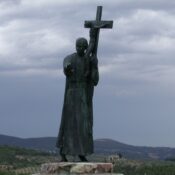
He was born in 1506 in the province of Navarre (Spain). He met Saint Ignatius of Loyola at the Sorbonne University in Paris. Ordained a priest in 1537 in the Italian city of Venice, he began his ministry in Rome. At the request of the King of Portugal, he was sent to India as a missionary, some parts of that territory being under Portuguese rule. He carried with him a missionary crucifix, a breviary, a Bible, and some personal belongings.
From Lisbon to Goa by boat… Japan and China
The boat trip from Lisbon to Goa took about thirteen months, becoming tiring due to the scarcity of food, the intense heat, and the storms.
When he arrived in Goa in May 1542, Xavier chose the city's hospital as his home and the bed of the most seriously ill patient. From then on, his ministry was dedicated precisely to assisting the least and most excluded members of society: the sick, prisoners, slaves, and abandoned children.
In the city of Goa (India), he began to dedicate himself to the sick, the poor, and children, whom they called the "Great Father." For the children, he created a new method of teaching the Catechism: he would go to the streets to find them, ringing a small bell; then, upon gathering them in the church, he would translate the principles of Catholic Doctrine into verses that he sang with the children, facilitating their learning. For two years he dedicated himself to the evangelization of the pearl fishermen, residents of southern India, who spoke only Tamil. However, Francis managed to transmit the principles of the Catholic faith to them, baptizing 10,000 in just one month. "The multitude of converts was so great," he wrote, "that at times my arms ached from so much baptizing, and I even lost my voice and strength to repeat the Creed and the Commandments in their language." He faced several dangerous situations, convinced that trust in God is a good antidote. Upon meeting a Japanese fugitive named Hanjiro, eager to convert to Christianity, Xavier was inspired to also go to Japan. He did reach the country, and despite not knowing the language or customs, he converted a great number of people, whom he called "the delight of my soul." His great dream was to evangelize China, but he was unable to fulfill it, as he died in 1552 on the island of Sancian while awaiting permission to embark. He was canonized by Pope Gregory XV in 1622.

St. Gaspar del Bufalo, as a young child of only a few months old, was miraculously cured of an eye disease that would have caused him possible blindness through the intercession of St. Francis Xavier: his mother obtained this grace by praying before the relic of St. Francis Xavier, which is located in the Church of Jesus in Rome. For this reason, Gaspar nurtured a devotion to the great missionary from a very early age, allowing himself to be inspired by his missionary spirit, choosing him as a role model and as the patron saint of the Congregation of the Missionaries of the Precious Blood.
Maria de Matias also chose the “glorious St. Francis Xavier as protector of the Institute,” as she herself wrote in the Rule of 1838 and 1857. The Adorers of the Blood of Christ nurture a filial devotion to him, invoking him as their patron. (Fr. Luís Filipe)